General Description
Earn the Security Fundamentals and Cybersecurity Protection Certification in Just 10 Days and Start Your Cybersecurity Career
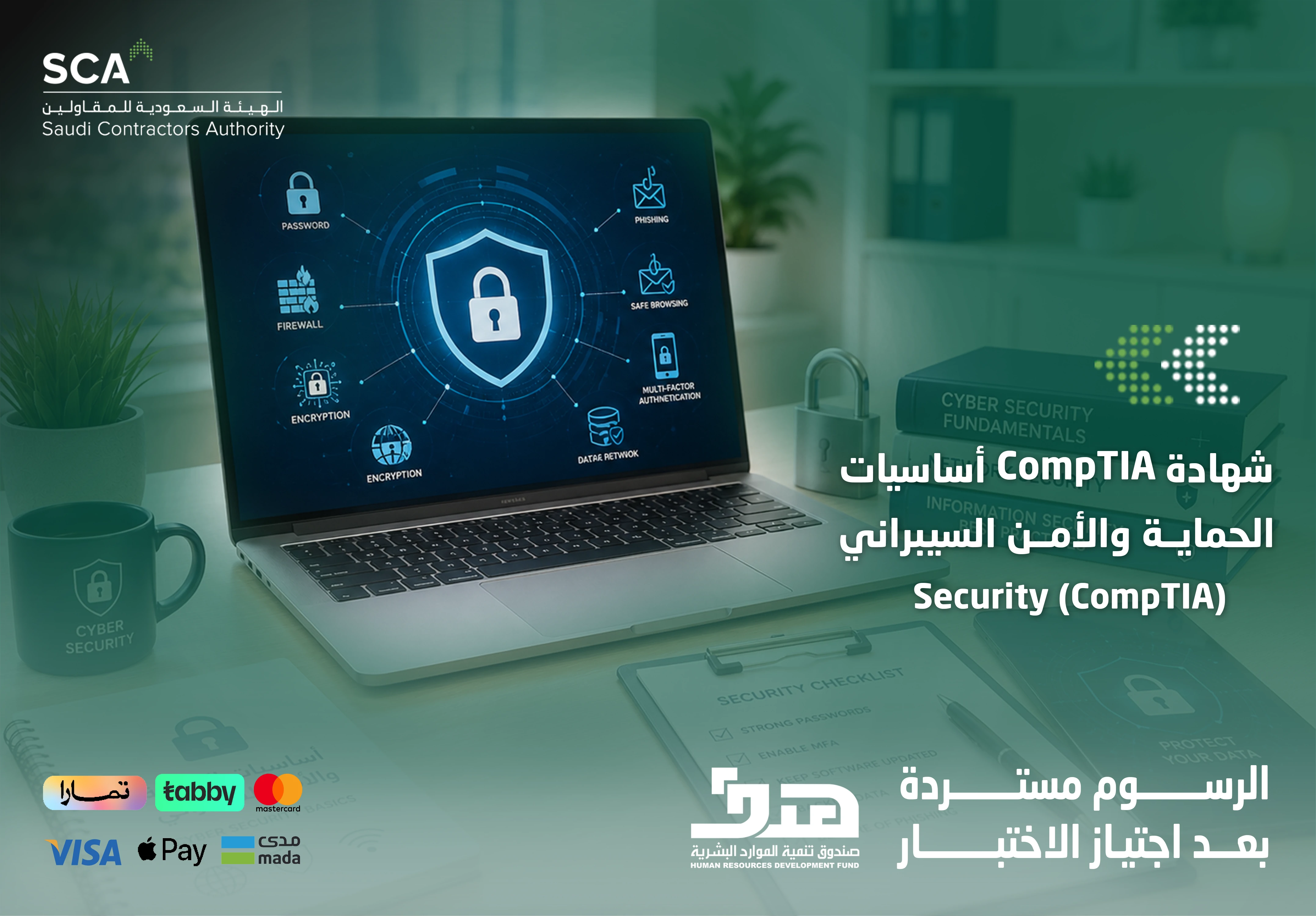
The Security Fundamentals and Cybersecurity Protection Certification is considered an important professional certification that helps you develop your knowledge and skills in protecting systems, networks, and data within modern work environments. Through the online training program, you can study the program in just 10 days with 60 training hours and prepare to pass the CompTIA Security certification in a practical and structured way that meets the needs of the Saudi Arabian job market.
The program also focuses on developing participants' skills in applying and implementing innovative technological solutions in line with organizational needs, making the CompTIA Security certification a suitable option for those seeking to build a strong future in cybersecurity in the Kingdom. Contact us now to register.
The Goals
CompTIA Security+ Certification Objectives
The Security Fundamentals and Cybersecurity Protection Certification aims to provide learners with the foundational knowledge and practical skills needed to understand cybersecurity principles and protect systems, networks, and digital information against security risks and threats. The certification also helps learners build a solid foundation for understanding security practices used in modern work environments.
The key objectives of the certification include:
-
Understanding cybersecurity fundamentals and becoming familiar with the core concepts and principles related to information and digital system protection.
-
Identifying cybersecurity threats and attacks, including common security risks and vulnerabilities that may affect systems, networks, applications, and digital assets.
-
Understanding system, network, and application security practices and recognizing key controls and measures used to strengthen an organization's security posture.
-
Learning the fundamentals of security incident response and understanding the basic processes used to identify, respond to, and mitigate the impact of security incidents.
-
Understanding governance, risk management, and security compliance concepts and their role in establishing an effective approach to managing cybersecurity risks.
-
Developing practical cybersecurity skills by gaining an understanding of how security controls, practices, and solutions can be applied in real-world environments.
-
Building a professional foundation in cybersecurity that supports further learning and prepares learners to understand the requirements of entry-level security-related roles.
The value of the CompTIA Security+ certification lies in its broad coverage of essential cybersecurity concepts and practical skills, helping learners develop a balanced understanding of both the theoretical and practical aspects of information and system security.
If you are looking to strengthen your cybersecurity fundamentals and build a professional foundation in this field, explore the program and available training pathway through the Saudi Contractors Authority platform.
Target Auidence
Target Audience for the Security Fundamentals and Cybersecurity Protection Certification
The Security Fundamentals and Cybersecurity Protection Certification is suitable for individuals who want to develop their understanding of core cybersecurity concepts and learn more about protecting systems, networks, and digital information. It can benefit both those beginning their professional journey and professionals with existing technical experience.
The certification is particularly relevant to:
-
Information security and network professionals who want to strengthen their understanding of fundamental cybersecurity concepts and practices.
-
IT professionals and administrators looking to expand their technical knowledge and move toward cybersecurity-related roles.
-
Individuals interested in data and digital asset protection who want to understand common security risks and approaches to mitigating them.
-
University students and recent graduates seeking to establish a foundation for a career in cybersecurity or related technology fields.
-
Technology professionals who want to enhance their knowledge of system, network, and application security.
-
Professionals seeking career development who want to build foundational knowledge relevant to a range of cybersecurity-related roles.
The certification is particularly suitable for individuals who want to build a strong cybersecurity foundation before progressing into more specialized and advanced areas of information security.
If you are looking to strengthen your cybersecurity knowledge and develop your understanding of how systems and digital information can be protected, explore the training program available through the Saudi Contractors Authority platform.
The Features
Benefits of the Security Fundamentals and Cybersecurity Protection Certification
The CompTIA Security+ certification provides learners with a comprehensive foundation in cybersecurity concepts and helps them develop a practical understanding of security risks, threats, and approaches to protecting systems and digital information. It can be a suitable option for individuals starting a career in cybersecurity as well as professionals looking to strengthen their technical knowledge.
Key benefits of the certification include:
-
A professional certification issued by CompTIA, an organization specializing in professional certifications for information technology and cybersecurity.
-
A strong foundation in cybersecurity through an understanding of core concepts and practices related to systems and information protection.
-
Greater awareness of cybersecurity threats, vulnerabilities, and attacks, along with fundamental approaches to addressing and mitigating security risks.
-
A stronger understanding of system, network, and data protection, including the security controls and practices used in professional environments.
-
An understanding of risk management and incident response fundamentals, providing learners with a broader view of cybersecurity operations.
-
Support for professional development in cybersecurity by building knowledge that can serve as a foundation for pursuing more specialized security areas.
-
Broad relevance to learners and technology professionals, including students, graduates, IT professionals, and individuals seeking to transition into cybersecurity.
The value of the certification extends beyond theoretical knowledge. It helps learners develop a structured understanding of key cybersecurity areas, from identifying risks and threats to understanding security controls, incident response, and risk management principles.
For individuals looking to establish a professional foundation in cybersecurity and strengthen their knowledge for modern technology-focused work environments, CompTIA Security+ can be a valuable step in their professional development. Explore the training program available through the Saudi Contractors Authority platform and take the next step toward developing your cybersecurity knowledge.
Topics
CompTIA Security+ Certification Topics and Training Modules
The CompTIA Security+ certification covers a broad range of essential cybersecurity topics, helping learners develop a comprehensive understanding of security threats, system and network protection, security operations, incident response, risk management, and compliance. The main areas include:
Module 1: Threats, Attacks, and Vulnerabilities
This module focuses on understanding cybersecurity threats, attack techniques, and vulnerabilities that may be exploited by threat actors. It covers:
-
Comparing different types of social engineering techniques.
-
Analyzing indicators that can help identify different types of cyberattacks.
-
Analyzing indicators associated with application-based attacks and vulnerabilities.
-
Analyzing indicators associated with network-based attacks.
-
Understanding different threat actors, attack vectors, and threat intelligence sources.
-
Understanding security concerns associated with different types of vulnerabilities.
-
Summarizing techniques used in security assessments.
-
Understanding the fundamental techniques and concepts involved in penetration testing.
Module 2: Security Architecture and Design
This module examines how cybersecurity principles can be incorporated into the design and architecture of technology environments, including:
-
Understanding the importance of security concepts within enterprise environments.
-
Summarizing virtualization and cloud computing concepts and their security implications.
-
Understanding secure application development, deployment, and automation concepts.
-
Summarizing authentication and authorization design concepts.
-
Applying cybersecurity resilience principles based on specific security scenarios.
-
Understanding the security implications of embedded and specialized systems.
-
Explaining the importance of physical security controls.
-
Summarizing fundamental cryptographic concepts and their role in protecting information.
Module 3: Security Implementation
This module focuses on the practical implementation of cybersecurity controls and solutions, including:
-
Implementing and using secure protocols.
-
Implementing host and application security solutions.
-
Implementing secure network designs.
-
Configuring wireless security settings and appropriate security controls.
-
Implementing secure mobile solutions.
-
Applying cybersecurity solutions and practices in cloud environments.
-
Implementing identity and account management controls.
-
Implementing authentication, authorization, and access management solutions.
-
Understanding public key infrastructure (PKI) and its security applications.
Module 4: Security Operations and Incident Response
This module addresses the processes and practices used to identify, investigate, and respond to cybersecurity incidents while reducing their impact. It covers:
-
Selecting appropriate tools for assessing an organization's security posture.
-
Understanding the importance of policies, processes, and procedures for incident response.
-
Identifying appropriate data sources to support security investigations.
-
Applying mitigation techniques and controls to secure the technology environment.
-
Understanding the key principles and practices of digital forensics.
Module 5: Governance, Risk, and Compliance
This module focuses on the organizational and management aspects of cybersecurity, including:
-
Comparing different types of security controls and their role in protecting organizational assets.
-
Understanding the importance of regulations, standards, and frameworks that influence organizational security.
-
Understanding the role of security policies in establishing and governing security practices.
-
Summarizing risk management processes and core risk management concepts.
-
Understanding privacy and sensitive data concepts in relation to information security and cybersecurity.
Together, these modules provide CompTIA Security+ learners with broad coverage of fundamental cybersecurity concepts, from identifying threats, attacks, and vulnerabilities to implementing security solutions, managing security operations, responding to incidents, and understanding governance, risk, and compliance. This comprehensive structure helps learners build a balanced cybersecurity foundation that can support their continued professional development in the field.
Learning outcomes
CompTIA Security+ Certification Learning Outcomes
After completing the training program and meeting the certification examination requirements, learners are expected to develop a range of foundational cybersecurity knowledge and skills that can help them understand key security practices and contribute to protecting systems and information.
Key learning outcomes include:
-
Understanding security threats and vulnerabilities and recognizing indicators and techniques associated with different types of cyberattacks.
-
Applying fundamental system and network security principles and understanding controls and practices used to strengthen security.
-
Understanding security operations and incident response fundamentals, including the processes used to address security incidents and reduce their potential impact.
-
Understanding governance, risk management, and compliance principles and their role in managing cybersecurity within organizations.
-
Contributing to the protection of data and digital assets by applying appropriate cybersecurity knowledge and practices in professional environments.
-
Understanding application, cloud, and mobile security fundamentals and the security considerations associated with modern technology environments.
-
Understanding basic cryptography, identity, and access management concepts and their role in protecting systems and information.
-
Building a strong professional foundation in cybersecurity that can support further training and specialization in different areas of information security.
These learning outcomes help learners develop a well-rounded cybersecurity foundation covering threats, protection, security operations, incident response, risk management, and compliance, providing a basis for continued professional development in the field.
If you are looking to strengthen your cybersecurity knowledge and build a professional foundation for your career, explore the training program and available learning pathway through the Saudi Contractors Authority platform.
Requirements And Conditions
CompTIA Security+ Certification Requirements
CompTIA Security+ is a professional cybersecurity certification suitable for individuals who want to establish a strong foundation in information security. Advanced cybersecurity experience is not necessarily required to pursue the certification; however, having a basic understanding of information technology can help learners understand the certification topics more effectively.
Key requirements and recommended preparation include:
-
Basic knowledge of information technology, including general concepts related to systems, networks, and technology infrastructure.
-
Preparation for the CompTIA Security+ examination and fulfillment of the examination requirements established by the certification provider.
-
Familiarity with fundamental technical concepts, which can be particularly helpful when studying topics such as networking, identity and access management, systems, and security controls.
-
A willingness to develop cybersecurity knowledge and study key concepts related to threats, vulnerabilities, security controls, and security operations.
Learners do not necessarily need extensive professional cybersecurity experience before pursuing the certification. However, having a suitable IT foundation can make it easier to understand the technical concepts covered throughout the program.
If you have a basic IT background and want to strengthen your cybersecurity knowledge and prepare for the CompTIA Security+ certification, explore the training program available through the Saudi Contractors Authority platform.
FAQs
The Blog
Security Fundamentals and Cybersecurity Protection Certification
The Security Fundamentals and Cybersecurity Protection Certification is a professional certification that helps learners build a strong foundation in computer technology and cybersecurity while developing their ability to work with modern technologies and systems more effectively. The program focuses on developing the knowledge and skills required to understand fundamental security concepts, apply security controls, assess risks, and respond to security incidents in ways that meet the needs of organizations in Saudi Arabia.
Through the Saudi Contractors Authority Open Learning Platform, learners can access a structured training program designed to help them understand the fundamentals of cybersecurity and prepare for the CompTIA Security certification, supporting their professional development in information security and cybersecurity-related fields. Learners can also use practice tests during their preparation to assess their level of readiness and understanding before taking the official examination.
Security Fundamentals and Cybersecurity Protection Certification Price
Investing in the Security Fundamentals and Cybersecurity Protection Certification can be an important step for individuals seeking to develop their cybersecurity skills, particularly given the growing importance of cybersecurity and the increasing demand for qualified professionals in the Saudi Arabian job market.
-
Certification price: SAR 11,525 through the Saudi Contractors Authority Platform.
-
Certification validity: 3 years.
How to Obtain the CompTIA Security Certification
Obtaining the CompTIA Security certification requires following a structured set of steps that can help learners prepare effectively for the examination and gain the greatest benefit from the training program. These steps include:
-
Registering for the appropriate training program.
-
Studying the Security Fundamentals and Cybersecurity Protection Certification content and its key topics.
-
Understanding the theoretical and practical aspects of cybersecurity.
-
Practicing sample questions and reviewing the certification's core concepts.
-
Taking practice tests more than once to assess examination readiness.
-
Taking and successfully passing the CompTIA Security examination.
Through the Saudi Contractors Authority Education Platform, learners can prepare for the examination through an organized training program designed to help them understand the content and improve their readiness before taking the exam.
Career Fields After the Security Fundamentals and Cybersecurity Protection Certification
The Security Fundamentals and Cybersecurity Protection Certification helps learners develop knowledge and skills relevant to a range of cybersecurity and information technology roles, including:
-
Information Security Specialist.
-
Cybersecurity Analyst.
-
Network Security Administrator.
-
Data Protection Officer.
-
Incident Response Specialist.
-
Security Risk Management Specialist.
-
Security Governance and Compliance Specialist.
-
Technical Security Support Specialist.
-
Vulnerability and Security Testing Analyst.
Support for the Security Fundamentals and Cybersecurity Protection Certification
The Security Fundamentals and Cybersecurity Protection Certification is accredited by:
-
CompTIA.
-
The certification is also supported by the Human Resources Development Fund (Hadaf).
The support includes:
-
Maximum reimbursement for examination costs: SAR 1,525.
-
Training cost reimbursement: SAR 10,000.
-
Certification approval in the program: May 2023.
This support provides additional value to the CompTIA Security certification for learners in Saudi Arabia. The connection between the certification and available support programs also makes it a valuable training opportunity for individuals seeking professional development in cybersecurity and information security.
CompTIA Security Examination Details
The CompTIA Security examination includes the following key details:
-
Number of questions: 90 questions.
-
Question type: Multiple-choice questions.
-
Exam duration: 90 minutes.
-
Passing score: 750 out of 1000.
-
Exam price: USD 349, approximately SAR 1,309.
-
Certification validity: 3 years.
The examination assesses the candidate's ability to understand fundamental and relatively advanced cybersecurity concepts and apply them to practical situations involving security threats, system and data protection, incident response, and risk management.
Start your cybersecurity journey with the Security Fundamentals and Cybersecurity Protection Certification through the Saudi Contractors Authority Open Learning Platform, and develop the knowledge and skills that can support your professional path in cybersecurity and information security.