General Description
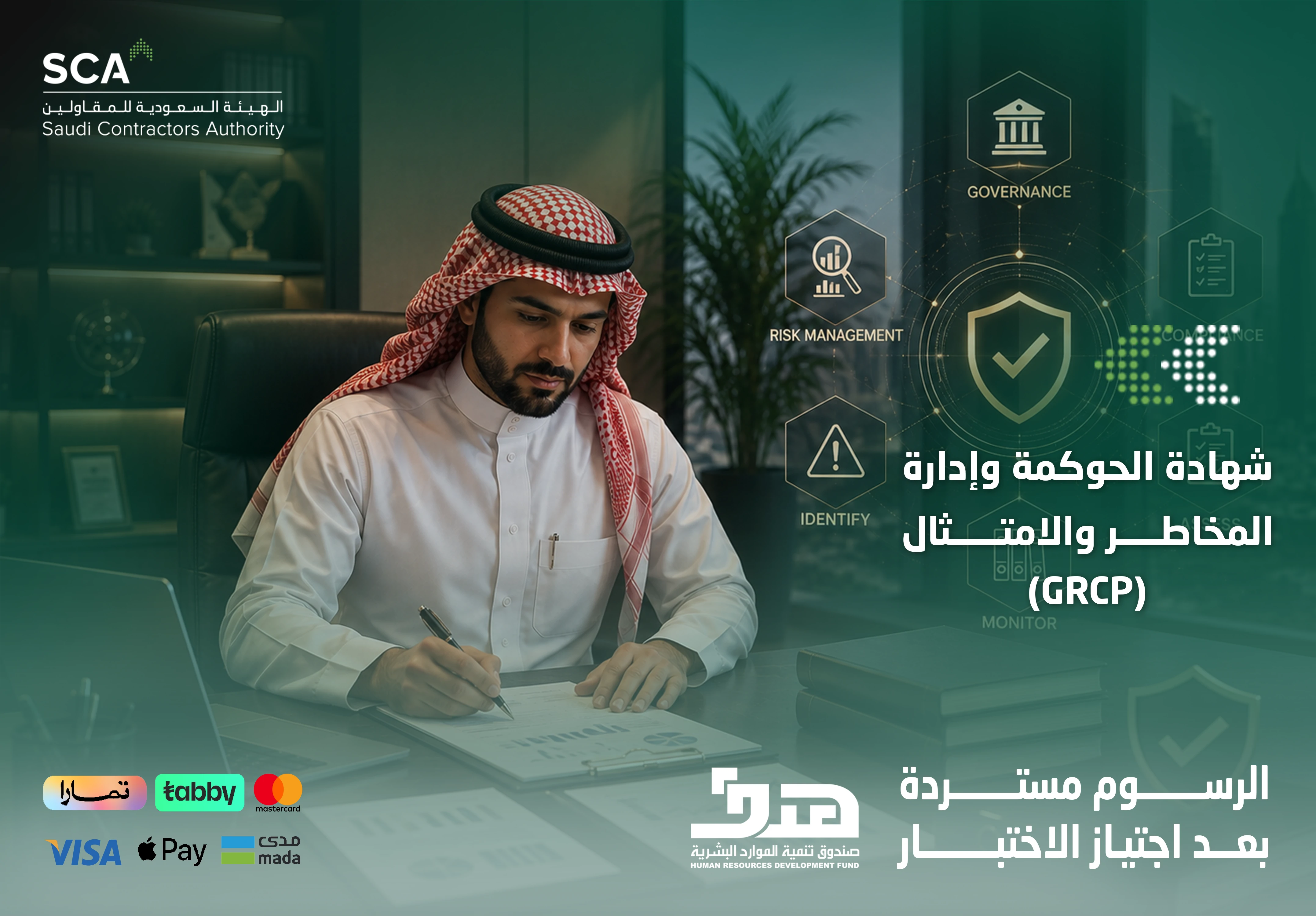
Governance, Risk and Compliance (GRCP) Certification
The Governance, Risk and Compliance (GRCP) Certification is a professional development opportunity for individuals working in governance, risk management, and compliance, as well as professionals seeking to build a comprehensive understanding of GRC concepts and their application in modern business environments.
The certification focuses on key principles and practices related to governance, risk management, and compliance, helping participants understand how these areas work together to support informed decision-making, strengthen organizational oversight, and manage risks and compliance requirements in a structured manner.
Through the Saudi Contractors Authority Open Learning Platform, participants can prepare for the GRCP certification through a remote training program delivered over 10 training days. The program is designed to provide learners with the knowledge needed to understand the GRC framework and apply its principles within the workplace.
The program is suitable for professionals looking to strengthen their capabilities in governance, risk management, and compliance, whether they aim to enhance their existing expertise or support their career development in GRC-related roles.
The program also includes the possibility of recovering the training cost, subject to the applicable terms and conditions, upon successfully meeting the certification requirements.
Start your professional development journey in Governance, Risk and Compliance through the Saudi Contractors Authority Open Learning Platform and strengthen your knowledge to meet the needs of modern professional environments.
The Goals
Objectives of the Governance, Risk and Compliance (GRCP) Certification
The Governance, Risk and Compliance (GRCP) Certification aims to develop a comprehensive understanding of GRC and help participants understand the relationship between governance, risk management, and compliance within an organization. The program also focuses on developing skills that support organizational oversight, informed decision-making, and structured management of risks and regulatory requirements.
Key objectives of the GRCP Certification include:
-
Understanding the relationship between governance, risk management, and compliance and the role each plays in supporting organizational objectives.
-
Recognizing the importance of GRC principles in strengthening transparency and organizational oversight.
-
Developing the ability to identify and analyze operational, financial, strategic, and technology-related risks.
-
Understanding professional frameworks and practices related to governance, risk management, and compliance.
-
Developing the skills needed to understand compliance requirements and align them with internal policies and procedures.
-
Becoming familiar with monitoring and control tools used to evaluate performance and improve organizational processes.
-
Developing the ability to identify weaknesses and areas of risk exposure and recommend appropriate corrective measures.
-
Strengthening the ability to prepare governance, risk, and compliance reports that support management decision-making.
-
Improving readiness to address regulatory and oversight requirements within organizations.
-
Preparing for the GRCP examination by developing the knowledge required across the certification's key subject areas.
Through the Saudi Contractors Authority Open Learning Platform, participants can follow a structured learning path designed to strengthen their GRC knowledge and improve their readiness for the certification requirements and the needs of modern professional environments.
Target Auidence
Target Audience for the Governance, Risk and Compliance (GRCP) Certification
The Governance, Risk and Compliance (GRCP) Certification is designed for a wide range of professionals working in governance, risk management, compliance, and related oversight functions. It is particularly relevant to individuals whose roles require an integrated understanding of GRC principles, including:
-
Senior and Executive Leaders: Professionals seeking to strengthen their ability to analyze risks and support strategic decision-making.
-
Internal Audit and Accounting Professionals: Individuals involved in internal controls, governance reporting, compliance, and assurance activities.
-
Governance, Risk, and Compliance Professionals: Specialists working in GRC functions within organizations who want to strengthen their professional knowledge.
-
Risk Management Specialists and Managers: Professionals looking to expand their expertise in applying governance principles and integrating them with risk management practices.
-
Regulatory and Oversight Professionals: Individuals working in roles involving policy compliance, internal procedures, and regulatory requirements.
-
Professionals Developing a Career in GRC: Individuals seeking specialized knowledge to support career growth or transition into governance, risk management, and compliance roles.
The certification is particularly suitable for professionals who want to develop an integrated understanding of governance, risk management, and compliance and apply relevant GRC concepts across different organizational environments.
The Features
Benefits of the Governance, Risk and Compliance (GRCP) Certification
The Governance, Risk and Compliance (GRCP) Certification helps professionals strengthen their knowledge and skills in GRC and develop a clearer understanding of how governance, risk management, and compliance work together to support organizational objectives and improve institutional practices.
The key benefits of the GRCP Certification include:
-
Strengthening GRC knowledge: Develop a comprehensive understanding of the relationship between governance, risk management, and compliance and how they interact within organizations.
-
Developing professional skills: Build knowledge that supports a more structured and systematic approach to governance, risk, and compliance matters.
-
Connecting concepts with practical application: Understand how GRC principles can be applied to analyze challenges and support organizational practices.
-
Supporting professional development: Add a specialized qualification to your professional profile if you are pursuing a career in governance, risk management, or compliance.
-
Enhancing decision-making capabilities: Develop an integrated perspective on organizational risks and regulatory requirements to support informed management decisions.
-
Improving understanding of the regulatory environment: Recognize the role of policies, controls, and monitoring mechanisms in strengthening compliance and organizational oversight.
-
Understanding the integrated GRC framework: Build a knowledge foundation that helps connect organizational objectives, risks, and compliance requirements.
The certification is offered through the Saudi Contractors Authority Open Learning Platform as part of a structured training path designed to strengthen participants' knowledge of governance, risk management, and compliance and prepare them for the certification requirements.
Topics
GRCP Certification Content
The Governance, Risk and Compliance (GRCP) Certification covers a range of topics designed to help participants understand the GRC framework and the relationship between governance, risk management, and compliance within organizations. Key topics include:
-
Governance, Risk, and Compliance Fundamentals: Understanding the core principles and leading practices related to these areas and how they can be managed in an integrated manner.
-
Integrating Governance, Risk, and Compliance: Understanding how GRC components can be connected to support organizational objectives, performance, and oversight.
-
Risk Management and Compliance Strategies: Exploring approaches for identifying and assessing risks and developing appropriate strategies to manage and reduce their potential impact.
-
Internal Controls: Understanding the role of internal control systems in monitoring organizational processes, supporting objectives, and improving operational effectiveness.
-
Regulatory Requirements Management: Understanding the importance of monitoring regulatory obligations and aligning them with internal policies and procedures.
-
Supporting Decision-Making: Understanding how risk, compliance, and internal control information can provide valuable insights for informed management decisions.
This content helps participants build a structured foundation in governance, risk management, and compliance while strengthening their readiness to apply GRC concepts within professional environments.
Learning outcomes
Skills Gained from the Governance, Risk and Compliance (GRCP) Certification
The Governance, Risk and Compliance (GRCP) Certification helps participants develop professional skills that support the understanding and application of GRC principles within organizations. Key skills that can be developed through the program include:
-
Applying governance and compliance principles: Understanding how governance and compliance concepts can be incorporated into organizational policies, procedures, and practices.
-
Effective risk management: Developing the ability to identify, assess, and address risks in ways that support business continuity and organizational objectives.
-
Risk and compliance analysis: Analyzing risks and regulatory obligations and identifying areas that may require corrective or preventive action.
-
Integrating GRC components: Connecting governance, risk management, and compliance within an integrated framework that supports organizational strategy and objectives.
-
Professional reporting: Developing the ability to organize and communicate governance, risk, and compliance information in a clear manner that supports decision-makers.
-
Supporting management decisions: Using risk, compliance, and internal control information to provide clearer input into organizational decision-making.
-
Addressing regulatory challenges: Developing a structured approach to understanding and managing regulatory requirements within the workplace.
These skills provide a professional foundation in GRC and can be applied across various roles related to governance, risk management, compliance, internal audit, and organizational oversight.
Requirements And Conditions
Requirements for Obtaining the GRCP Certification
To obtain the Governance, Risk and Compliance (GRCP) Certification, participants need to complete the relevant training requirements and meet the requirements for the certification examination. The main requirements include:
- Enroll in the training program: Register for the preparatory program offered through the Saudi Contractors Authority Open Learning Platform and complete the required training content.
- Prepare for the examination: Study the key topics and subject areas covered by the GRCP program and prepare for the final assessment.
- Pass the GRCP examination: Complete the international GRCP examination and meet the passing requirements established by the awarding organization.
Participants are advised to review the latest official certification requirements before registration, as eligibility criteria and examination procedures may vary depending on the awarding organization and the applicable program version.
FAQs
The Blog
GRCP Certification Cost, Duration and Exam Preparation in 2026
Understanding the cost of the Governance, Risk, and Compliance Professional (GRCP) certification is an important step for professionals planning to develop their careers in governance, risk management, and compliance. The overall cost may vary depending on the training provider and the services included in the training and preparation program.
The GRCP program available through the platform is priced at SAR 7,300 according to the published program price. Eligible Saudi professionals may also be able to benefit from the Human Resources Development Fund (HRDF – Hadaf) Professional Certification Support Program, provided that the certification and applicant meet the applicable eligibility requirements. Reimbursement is not automatic and remains subject to HRDF's rules, documentation, and verification procedures.
If you are planning to strengthen your knowledge of governance, risk management, and compliance and prepare for the GRCP certification, contact us to learn more about the available program and registration options.
GRCP Program Duration
The GRCP training program is delivered online and consists of 30 training hours over approximately 10 training days, according to the program details available through the platform.
Online delivery provides flexibility while focusing on the core concepts and knowledge required to prepare for the GRCP examination and understand the practical relationship between governance, risk, and compliance.
Training duration: 30 hours
Program length: 10 training days
Delivery method: Online
Professional certification: GRCP – GRC Professional
It is important to distinguish between the duration of the training program and the amount of time an individual may need to prepare for the examination. Preparation time can vary depending on previous professional experience and familiarity with GRC concepts.
How Can You Prepare for the GRCP Exam?
Effective GRCP preparation involves more than memorizing terminology. Candidates should understand how governance, risk management, and compliance interact and how these concepts can be applied in organizational environments.
A structured preparation approach can include:
-
Study the core certification knowledge:
Build a solid understanding of the concepts and principles that form the foundation of GRC. -
Understand how GRC disciplines connect:
Focus on the relationship between governance, risk management, and compliance rather than studying each discipline in isolation. -
Connect concepts with practical situations:
Apply the concepts to realistic organizational scenarios to strengthen your understanding. -
Practice with exam-style questions:
OCEG provides preparation resources and sample questions to help candidates become familiar with the examination approach. -
Manage your exam time effectively:
The GRCP examination consists of 100 questions and has a 120-minute time limit. Candidates need to answer 70 questions correctly to pass.
A structured study plan, combined with core knowledge review and practical question practice, can therefore help candidates approach the examination with greater confidence and readiness.
What Is the GRCP Certification Pathway?
According to OCEG, the certification pathway involves joining its certification program, selecting the appropriate certification, preparing for the examination, taking the exam, and maintaining the certification through its continuing professional education requirements.
OCEG also provides preparation resources such as GRC Fundamentals, knowledge resources, and sample questions to help candidates develop their understanding of GRC and prepare for the examination.
Can the GRCP Cost Be Reimbursed by Hadaf?
Eligible Saudi professionals may benefit from the Professional Certification Support Program provided by the Human Resources Development Fund (HRDF – Hadaf), provided that the certification is included in the approved list and the applicant meets the program's eligibility requirements.
According to HRDF, eligibility includes requirements related to Saudi nationality, the certification's inclusion in the approved certification list, the date on which the certification was obtained, supporting invoices, and whether the applicant's employer has already covered the certification cost. Applications are reviewed and verified before reimbursement is issued.
For this reason, applicants should verify the current certification approval status and reimbursement requirements at the time of application rather than assuming that reimbursement is automatically guaranteed.
Start Your GRCP Preparation
For professionals working or planning to work in governance, risk management, compliance, internal audit, or organizational controls, developing an integrated understanding of GRC can support professional development and provide a clearer view of how these functions work together within an organization.
Contact us to learn more about the GRCP program, online learning format, available schedules, registration process, and exam preparation.