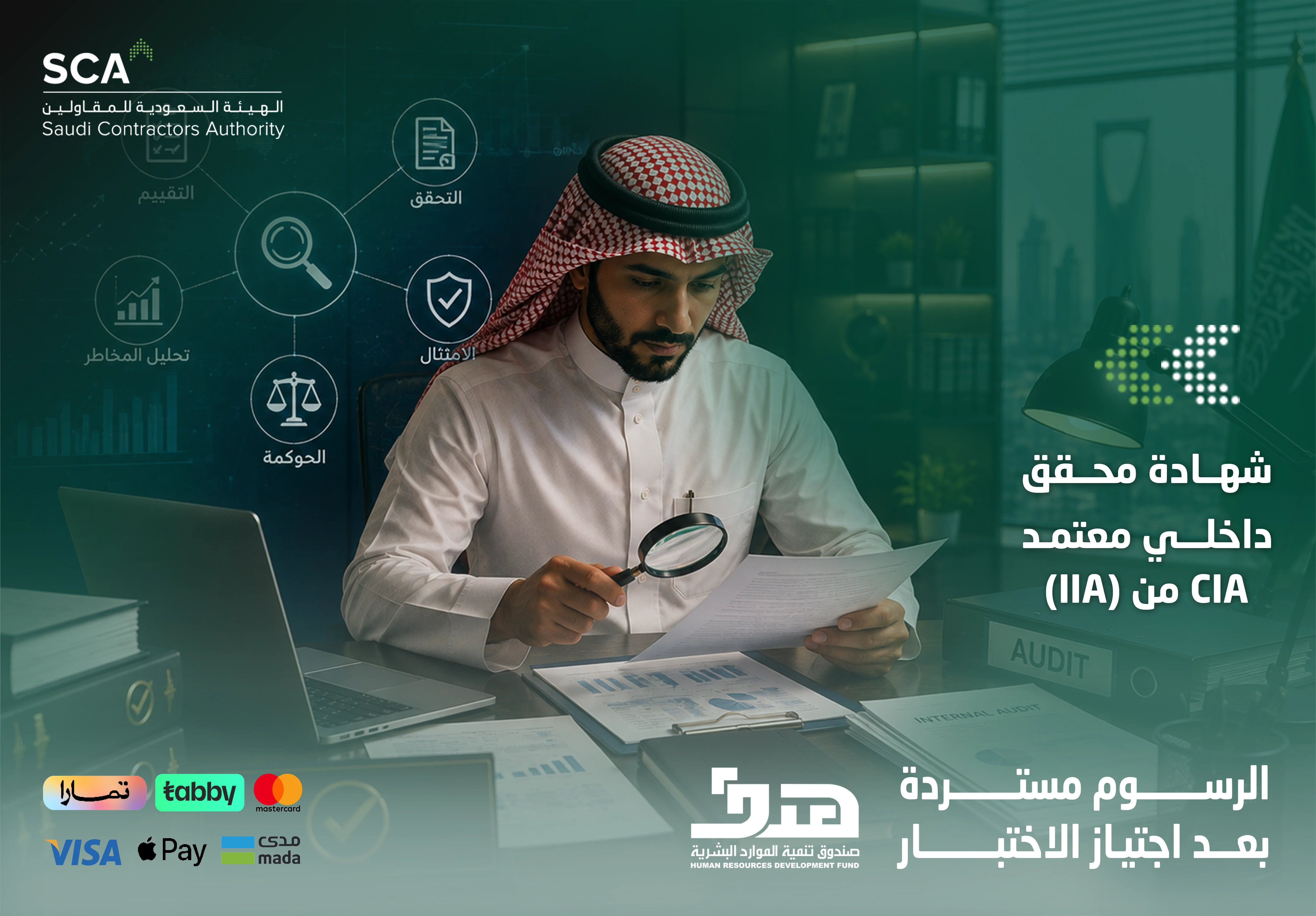
General Description
The Certified Internal Auditor (CIA) certification is one of the most recognized global professional credentials in internal auditing, governance, and risk management. It provides professionals with the knowledge and skills required to evaluate internal control systems, assess risks, and contribute to improving organizational performance.
The CIA certification prepares qualified professionals who can apply international internal auditing standards and understand best practices in auditing, compliance, and risk management, helping organizations enhance transparency and strengthen governance.
Through the training program provided by the Saudi Contractors Authority, participants receive professional preparation that helps them develop their internal auditing skills and prepare for an internationally recognized certification that aligns with the requirements of the Saudi labor market.
This certification is an ideal choice for auditors, accountants, governance and risk management professionals, as well as individuals seeking to build a specialized career path in internal auditing.
The Goals
Objectives of the Certified Internal Auditor (CIA) Certification
The Certified Internal Auditor (CIA) certification aims to develop professional competencies in internal auditing by providing participants with the knowledge and skills required to evaluate control systems, analyze risks, and apply best practices according to international standards.
The certification focuses on enhancing participants’ understanding of the role of internal auditing within organizations, supporting data-driven decision-making, improving operational procedures, and strengthening corporate governance.
Through this certification, participants will be able to:
- Understand the fundamental principles of internal auditing and its role in improving organizational performance.
- Apply auditing methodologies according to international professional standards.
- Develop risk assessment skills and evaluate internal control systems.
- Provide recommendations that help organizations improve processes and reduce risks.
- Enhance knowledge of governance principles, compliance, and internal auditing ethics.
Target Auidence
Target Audience for the Certified Internal Auditor (CIA) Certification
The Certified Internal Auditor (CIA) certification is designed for professionals and individuals seeking to enhance their expertise in internal auditing, governance, and risk management, whether they are currently working in financial fields or aiming to build a career in this specialization.
The certification is suitable for:
- Internal auditors seeking to strengthen their expertise and earn an international professional credential.
- Accountants and financial professionals looking to improve their auditing and control skills.
- Professionals working in governance, compliance, and risk management departments.
- Financial and administrative employees seeking to understand control systems and improve processes.
- Accounting and business administration graduates interested in pursuing a career in internal auditing.
The Features
Benefits of Obtaining the Certified Internal Auditor (CIA) Certification
The Certified Internal Auditor (CIA) certification provides professionals with valuable career benefits that help them enhance their expertise and strengthen their position in the job market, especially as organizations increasingly rely on governance, control systems, and risk management practices.
The CIA certification demonstrates that holders possess specialized knowledge in internal auditing and the ability to apply global standards for evaluating processes and improving internal control systems.
The key benefits of obtaining the CIA certification include:
- Earning an internationally recognized professional credential in internal auditing.
- Developing risk assessment skills and evaluating the effectiveness of internal control systems.
- Enhancing career opportunities and professional advancement in auditing, governance, and compliance fields.
- Gaining the ability to apply international professional internal auditing standards.
- Improving data analysis skills and supporting information-based decision-making.
- Increasing the ability to help organizations improve processes and reduce operational and financial risks.
- Building a strong professional career path in financial, administrative, and corporate sectors.
Topics
Modules of the Certified Internal Auditor (CIA) Certification
The Certified Internal Auditor (CIA) certification covers professional modules designed to develop participants’ capabilities in internal auditing, risk management, governance, and organizational control.
The certification modules provide participants with the knowledge required to understand the internal auditor’s role, perform audit engagements effectively, analyze business environments, and provide recommendations that improve organizational performance.
1- Essentials of Internal Auditing
This module focuses on the fundamental principles required for internal auditors, including:
- Understanding internal auditing concepts, objectives, and its role in supporting organizations.
- Learning governance, risk management, and internal control principles.
- Understanding professional standards for internal auditing practices.
- Recognizing the importance of independence, objectivity, and professional ethics.
2- Internal Audit Practice
This module covers the practical aspects of internal audit activities, including:
- Planning audit engagements and preparing audit programs.
- Collecting and analyzing audit evidence and information.
- Performing audit procedures through systematic approaches.
- Preparing audit reports and developing professional recommendations.
3- Risk Management and Internal Controls
This module helps participants understand risk assessment and control improvement through:
- Identifying potential organizational risks.
- Evaluating the effectiveness of internal controls.
- Analyzing operational and financial processes.
- Providing solutions to reduce risks and improve performance.
4- Business Knowledge and Data Analysis
This module develops auditors’ understanding of business and operational environments, including:
- Understanding financial and administrative processes.
- Analyzing data and using modern technologies in auditing.
- Learning financial management concepts and decision-making principles.
- Evaluating operational performance and supporting continuous improvement.
Learning outcomes
Outcomes of the Certified Internal Auditor (CIA) Certification
After completing the Certified Internal Auditor (CIA) certification, participants gain professional skills that enable them to perform internal audit activities effectively, analyze risks, and evaluate control systems according to international standards.
The certification outcomes prepare participants to play a more effective role in supporting organizations, improving operational performance, and strengthening compliance and governance.
Key learning outcomes include:
- Performing internal audit engagements according to global professional standards.
- Evaluating internal control systems and identifying improvement opportunities.
- Analyzing risks and providing recommendations to enhance operational efficiency.
- Preparing professional audit reports that support management decision-making.
- Applying governance, compliance, and internal auditing ethics principles.
- Using data analysis tools to support audit and evaluation activities.
- Enhancing readiness for careers in internal auditing, financial review, and risk management.
Requirements And Conditions
Requirements for the Certified Internal Auditor (CIA) Certification
To obtain the Certified Internal Auditor (CIA) certification, applicants must meet a set of requirements established by The Institute of Internal Auditors (IIA). These requirements ensure that candidates have the appropriate academic background and professional experience needed to practice internal auditing according to international standards.
The CIA certification requirements include:
- Educational Qualification:
Holding an accredited academic qualification such as a bachelor’s degree or equivalent, according to the IIA requirements. - Professional Experience:
Having practical experience in internal auditing or related fields such as accounting, financial review, internal control, or risk management. - Passing the CIA Exam:
Successfully completing all required CIA exam parts to earn the professional credential. - Commitment to Professional Standards:
Agreeing to follow the internal auditing code of ethics and internationally recognized professional standards. - Continuing Professional Education:
Maintaining the certification by fulfilling continuing professional development requirements.
FAQs
The Blog
Certified Internal Auditor (CIA) Exam Details
The Certified Internal Auditor (CIA) exam is a specialized professional assessment designed to measure candidates’ understanding of internal auditing concepts and their ability to apply them in different business environments.
The exam evaluates professional knowledge in auditing, risk management, governance, internal controls, and business analysis to ensure candidates can perform internal audit activities according to global standards.
CIA Exam Parts
Part One: Essentials of Internal Auditing
This part covers the fundamental concepts of internal auditing, including:
- Governance, risk management, and control principles.
- The role and responsibilities of internal auditors.
- Independence, objectivity, and professional ethics.
- Basic audit planning concepts.
Part Two: Internal Audit Practice
This part focuses on practical internal auditing skills, including:
- Performing audit engagements and evaluating processes.
- Collecting and analyzing audit evidence.
- Identifying risks and improvement opportunities.
- Preparing professional audit reports.
Part Three: Business Knowledge for Internal Auditing
This part covers essential business knowledge, including:
- Financial and accounting management.
- Information technology and data analysis.
- Operations management and decision-making.
- Understanding organizational business environments.
Awarding Body of the Certified Internal Auditor (CIA) Certification
The Certified Internal Auditor (CIA) certification is awarded by The Institute of Internal Auditors (IIA), a global organization dedicated to developing the internal auditing profession and establishing professional standards in this field.
The Institute of Internal Auditors supports professionals worldwide by developing auditing standards and providing certifications and educational programs that improve the quality of internal audit practices.
The CIA certification is considered a global benchmark in internal auditing, demonstrating that holders possess the knowledge and skills required to evaluate control systems, manage risks, and support organizational governance.
Certified Internal Auditor (CIA) Certification Cost in Saudi Arabia 2026
The Certified Internal Auditor (CIA) certification cost represents an important professional investment for individuals seeking to advance their expertise in internal auditing, governance, and risk management. The certification provides holders with a competitive advantage in both the Saudi and global job markets.
The training program cost for the Certified Internal Auditor (CIA) certification is:
- Approximately SAR 8,000 (around USD 2,130).
The training program helps participants understand certification topics, develop the required skills for exam preparation, and gain knowledge of professional standards used in internal auditing.
Through the Saudi Contractors Authority, participants receive specialized training that supports their preparation for the CIA certification and enhances their career opportunities in auditing, control, and governance fields.
For professionals seeking career growth in internal auditing, earning the CIA certification represents an important step toward building internationally recognized expertise.
Training Support for the Certified Internal Auditor (CIA) Certification
The Saudi Contractors Authority provides a specialized training program designed to help participants prepare for the Certified Internal Auditor (CIA) certification through comprehensive training content focused on exam requirements and professional internal auditing practices.
The training support includes:
- Explaining fundamental and advanced internal auditing concepts.
- Understanding international standards for professional internal auditing practices.
- Applying theoretical concepts through practical workplace scenarios.
- Providing training materials to support exam preparation.
- Developing risk analysis and internal control evaluation skills.
This training support helps participants build a comprehensive understanding of internal auditing and improve their readiness to earn the CIA certification.
Tips for Certified Internal Auditor (CIA) Exam Candidates
Passing the Certified Internal Auditor (CIA) exam requires proper planning and structured preparation. Success depends on understanding internal auditing concepts and applying them effectively in practical situations.
The most important exam preparation tips include:
- Creating a clear study plan based on available time and professional goals.
- Reviewing international internal auditing standards and understanding key principles.
- Focusing on understanding concepts rather than memorization only.
- Practicing with sample exams to become familiar with question formats and improve time management.
- Applying acquired knowledge to practical workplace scenarios.
- Benefiting from specialized training programs to improve exam readiness.
Start preparing for the CIA exam through the specialized training programs provided by the Saudi Contractors Authority and develop your professional internal auditing skills.
Register for the Certified Internal Auditor (CIA) Certification
If you aim to advance your career in internal auditing, governance, and risk management, the Certified Internal Auditor (CIA) certification provides the knowledge and skills needed to achieve your professional goals and strengthen your expertise in the job market.
Through the training program provided by the Saudi Contractors Authority, you can receive specialized preparation that helps you understand internal auditing standards and prepare for an internationally recognized professional certification that enhances your career opportunities.
Start your professional journey today and enroll in the Certified Internal Auditor (CIA) certification program to develop your expertise in one of the most important fields of modern business.